
The Bottom Line
Rep. Gabe Evans has voted with the Trump/MAGA agenda on every major issue — cutting healthcare for his own constituents, spiking gas prices through a war he cheered on, making it harder to vote, and refusing to face the people he represents.
This is one of the most competitive districts in the country, and it can be won. Coloradans deserve a representative who actually shows up — for town halls, for working families, and for the constitutional duty to check executive power.
Change is possible — but only if we take action.
The Record
💰 Economy: Evans supports tax cuts for the wealthy while voting to cut healthcare, food assistance, and public education funding that working families in his district depend on - click for details
Tariffs & Consumer Costs
Rep. Evans says he wants to lower costs for families — but he has been a vocal supporter of tariffs on imported goods, policies that economists and polls widely associate with increased consumer prices. A Colorado poll found 59% of respondents believe Trump’s tariffs will hurt the state. Evans has aligned himself firmly with the Trump administration’s trade stance despite the unpopularity of that position in his district.
The “One Big Beautiful Bill” — Taxes & Medicaid
Rep. Evans voted YES on the sweeping “One Big Beautiful Bill,” a massive tax and spending package that includes major corporate tax benefits. Independent analyses — including from the Congressional Budget Office — project it will cut federal Medicaid spending by roughly $1 trillion over 10 years, leaving an estimated 11.8 million more Americans uninsured. 24% of Evans’ own constituents rely on Medicaid — nearly 1 in 4 people in his district. In Colorado alone, over 200,000 Medicaid enrollees could lose coverage; federal Medicaid spending in Colorado is projected to fall about 16%, roughly $14 billion over the decade. 70% of the bill’s tax benefits are estimated to go to the top 5% of earners, while costs rise for the bottom 40%. Evans has repeatedly claimed the bill does not cut Medicaid — a characterization that Medicaid policy experts have called misleading and factually incorrect.
Food Assistance (SNAP)
The same bill Evans supported added new eligibility requirements for SNAP (food stamps), which currently supports more than 1 in 10 low-income Coloradans. Colorado officials project the changes will cost the state an additional $57 million per year just to administer new work-requirement verification systems — costs that fall on state taxpayers with no evidence that such requirements actually increase employment.
School Vouchers & Public Education
Rep. Evans supports school choice voucher policies that redirect public funding to private education. The “One Big Beautiful Bill” included the first-ever major federal private school choice program. Data from states that have already implemented such programs show these funds disproportionately benefit families already enrolled in private schools: in Arkansas, 95% of voucher recipients were not previously in public schools; in Arizona, the wealthiest families used education savings accounts at five times the rate of the poorest. Research indicates voucher programs often reduce net funding for public schools that serve the majority of working-class children. Meanwhile, Evans himself does not send his own children to public school — by his own description, he is a “second-generation homeschooler” who homeschools his children.
🌍 Immigration: Evans champions aggressive enforcement using his family's immigration story as cover — but documents show that story is false, and the policies he supports would have deported his own grandfather - click for details
The Grandfather Story — Documented Contradiction
For years, Rep. Evans has invoked his grandfather Cuauhtemoc Chavez as proof that immigrants should “do it the right way, do it the legal way.” He has used this story repeatedly to justify mass deportation policies and strict enforcement. But federal immigration documents obtained by Colorado Newsline tell a different story.
According to archived INS records, Evans’ grandfather crossed into the U.S. illegally at age five in 1929 with his mother and siblings. Their entry documents read: “to live, illegal entry.” He lived in the U.S. without documentation for over 10 years before being arrested and subject to deportation proceedings. His record also included an arrest for attempted burglary.
He ultimately earned citizenship in 1946 after serving in World War II and receiving two Purple Hearts — a path Evans honors, but also one he omits key details about when citing it as a model for others. Evans also benefited from a 1944 law that eliminated proof of “lawful entry” as a citizenship requirement — a legal accommodation his grandfather needed and received, but which Evans now opposes extending to others.
The kicker: Evans was a vocal supporter of the Laken Riley Act, which mandates detention of any undocumented immigrant arrested for burglary. His own grandfather had an arrest record for attempted burglary. Under Evans’ own policy, his grandfather would have been deported.
Laken Riley Act — Expanding Detention, Reducing Due Process
Rep. Evans voted YES on the Laken Riley Act, one of the first bills passed under the new Congress. The law requires federal immigration agents to prioritize detention of any undocumented immigrant arrested — not convicted — for burglary, theft, larceny, or shoplifting. Critics argue it undermines due process by triggering mandatory detention based on an arrest alone, before guilt has been established, and significantly increases the risk of prolonged detention for people who may ultimately be found innocent.
His First Bill: Roll Back Colorado’s Immigrant Protections
The very first bill Evans introduced in Congress was the UPLIFT Act, which targeted three Colorado state laws designed to protect immigrants from detention based solely on their immigration status. Under his bill, Colorado law enforcement would be authorized to hold someone based only on suspicion of being in the country unlawfully — with no criminal charge required. It would also allow police to share an undocumented person’s personal information with federal agents without a warrant or court order.
While Evans frames this as targeting “dangerous criminals,” the bill’s own language authorizes civil detainers for violations of any “criminal or motor vehicle law” — meaning a speeding ticket could trigger detention. Colorado’s immigrant protection laws exist to ensure local police can focus on public safety while maintaining trust with immigrant communities, which researchers and law enforcement professionals have linked to lower crime rates.
ICE Enforcement, Sanctuary Policies, and Unsupported Claims
Rep. Evans has said enforcement should focus on serious criminals — “gangsters not grandmas.” But he has consistently supported ICE’s current broad enforcement approach and voted to fund the Department of Homeland Security with no new guardrails, oversight requirements, or reforms on ICE and CBP, despite mounting documented evidence of wrongful detentions, deaths in custody, and the targeting of people with no criminal records.
On his official House issues page, Evans states directly that Colorado’s sanctuary-related policies “have led to the presence of cartels and illegal criminal gangs like Tren de Aragua.” This is a causal claim — that local policies caused cartel activity — and it is not supported by evidence. Tren de Aragua is a transnational criminal organization that operates across many states and countries regardless of local immigration policies. Researchers and law enforcement experts have consistently found no evidence that sanctuary policies increase crime; multiple studies have found the opposite.
Sanctuary policies exist so that local law enforcement can focus on public safety without acting as federal immigration agents — a distinction that police departments across the country support because it maintains trust with immigrant communities. Misrepresenting these policies as a cause of cartel activity creates fear but does not reflect how crime or immigration enforcement actually works.
The Dignity Act — Reform or Political Cover?
In July 2025, Evans co-sponsored the bipartisan Dignity Act, which would create a pathway to legal status (not citizenship) for undocumented immigrants who entered before December 31, 2020, pay $7,000 in restitution, have no criminal history, and receive no federal benefits. The bill has drawn criticism from the right as “amnesty” and skepticism from the left as insufficient. Critics note it provides no path to citizenship, excludes anyone who entered after 2020, and pairs any relief with massive new enforcement measures including 24/7 border surveillance and mandatory nationwide E-Verify.
Evans’ district is nearly 40% Latino, and he faces a difficult reelection in 2026 — leading some observers to view the Dignity Act co-sponsorship as a political calculation rather than a genuine shift in values, given that his first bill in Congress was aimed at stripping immigrant protections in Colorado.
🗳 Voting Rights: Evans voted to make it harder to register to vote — and to undermine Colorado's mail-in voting system - click for details
The SAVE Act — Solving a Problem That Doesn’t Exist
Rep. Evans voted YES on the Safeguard American Voter Eligibility (SAVE) Act, which passed the House in April 2025. The bill requires Americans to present documentary proof of citizenship — such as a passport or birth certificate — to register to vote or update their registration. Evans praised the vote in a press release, framing it as protecting elections from noncitizen voters.
- Married women who have changed their last name and whose existing documents may not match their current legal name.
- Rural voters in Evans’ own district — in the 30 largest counties in the West by area, voters would have to drive an average of 260 miles to reach an election office to submit documents in person.
- Voters who register online or by mail — the bill effectively ends those methods since documents cannot easily be submitted remotely. In 2022, 23% of Americans registered online or by mail.
- Community voter registration drives — held at churches, campuses, and shopping centers — would largely be shut down since most people don’t carry their passport or birth certificate with them.
Criminalizing Election Workers
The bill also creates criminal penalties for election workers themselves. Under the SAVE Act, an election official could face up to five years in prison for registering someone without the correct documents — even if that person turns out to be a fully eligible citizen. The bill also opens election workers to costly private lawsuits from political actors. This provision puts enormous pressure on local officials and could deter good-faith election administration.
An Even Stricter Version in 2026 – But Evan’s Vote Is Unknown
The original SAVE Act stalled in the Senate. In February 2026, House Republicans passed the SAVE America Act — a strengthened version that adds mandatory photo ID requirements at the polls and for mail voters, requires all state voter rolls to be submitted to the Department of Homeland Security with no restrictions on how that data can be used, and includes no federal funding to help states implement the sweeping new requirements. Evans has not publicly stated how he voted or issued any statement on the bill — a notable silence from a congressman who issued a press release praising the original version.
⚔️ Iran War: Evans cheered on a war that spiked Colorado gas prices — then voted to make sure Congress can't do anything to stop it. - click for details
Evans Votes to Strip Congress of War Powers
On April 17, 2026, the House voted 213–214 to reject a War Powers Resolution that would have reined in President Trump’s ability to wage war on Iran without congressional authorization. Every House Republican voted against the resolution — except Kentucky’s Thomas Massie. Evans was among them. This was not a vote about whether to support the troops. It was a vote about whether Congress should exercise its constitutional duty to decide if and how the United States goes to war. Evans said no.
Evans Supported the War from Day One — The Same Day He Was Bragging About Low Gas Prices
The U.S.-Israeli war on Iran began on February 28, 2026. The timing could not be more ironic: just one day before Trump launched the conflict, Rep. Evans published an op-ed taking credit for low gas prices, citing Republican energy policy. The very next day, he threw his public support behind the war — despite Iran being the world’s fifth-largest oil producer, and despite the near-certain consequence that a war involving Iran would disrupt global oil markets and spike prices at the pump.
That is exactly what happened. Within days, oil prices soared above $100 a barrel. The average price of regular gas in the Denver metro area jumped by more than 50 cents in a single week, according to AAA. Even Trump’s own Energy Secretary, Chris Wright, flew to Colorado to do damage control alongside Evans and explicitly acknowledged that the price spike was tied to the Iran war.
Evans’ response was to blame Colorado Democrats and state energy regulations — the same talking point he deploys regardless of what is actually driving prices. By his own logic from his pre-war op-ed, Republicans own those gas prices now.
Concerns Without Accountability
In March 2026, Evans said he was “concerned” about the Trump administration potentially sending ground troops to the Middle East — but in the same breath refused to support any mechanism to actually prevent it, saying he didn’t want to “paint a hard line” that would limit Trump’s negotiating leverage. In other words: he expressed concern while voting to ensure Congress retains no power to act on that concern. Expressing worry about a war while voting to give the president unchecked authority to wage it is not a check on executive power — it is a performance of independence with none of the substance.
Meanwhile the conflict has already killed thousands of civilians in Iran according to human rights monitors, caused the U.S. military bases across the region to sustain hundreds of millions of dollars in damage, and disrupted global shipping through the Strait of Hormuz — a waterway through which a fifth of the world’s oil passes daily. The war has no formal authorization from Congress, no declared objective, and no defined endpoint.
⚖️ Accountability: Evans votes the Trump/MAGA line on every major issue — and has gone to extraordinary lengths to avoid facing his own constituents in person to answer for it. - click for details
Party-Line Voting: No Independence on Major Issues
On every major vote of his tenure, Rep. Evans has sided with the Trump agenda: the Laken Riley Act, the One Big Beautiful Bill (Medicaid cuts, tax breaks for the wealthy, school vouchers), the SAVE Act, and DHS funding with no oversight reforms. He has not broken with his party on a single significant piece of legislation. Colorado Newsline noted that despite representing one of the most closely divided swing districts in the country — one he won by just 2,500 votes — Evans “has done little to distance himself from Trump and his agenda.”
Trump himself has endorsed Evans twice and praised him as an “America First Patriot.” Evans thanked the president and responded by promising to continue cracking down on immigration. The relationship is one of mutual reinforcement, not independent representation.
A representative of a swing district is supposed to reflect the full range of his constituents — not serve as a rubber stamp for a national party agenda. Evans’ voting record suggests his allegiance runs to Washington, not to Colorado’s 8th.
Refusing to Hold In-Person Town Halls
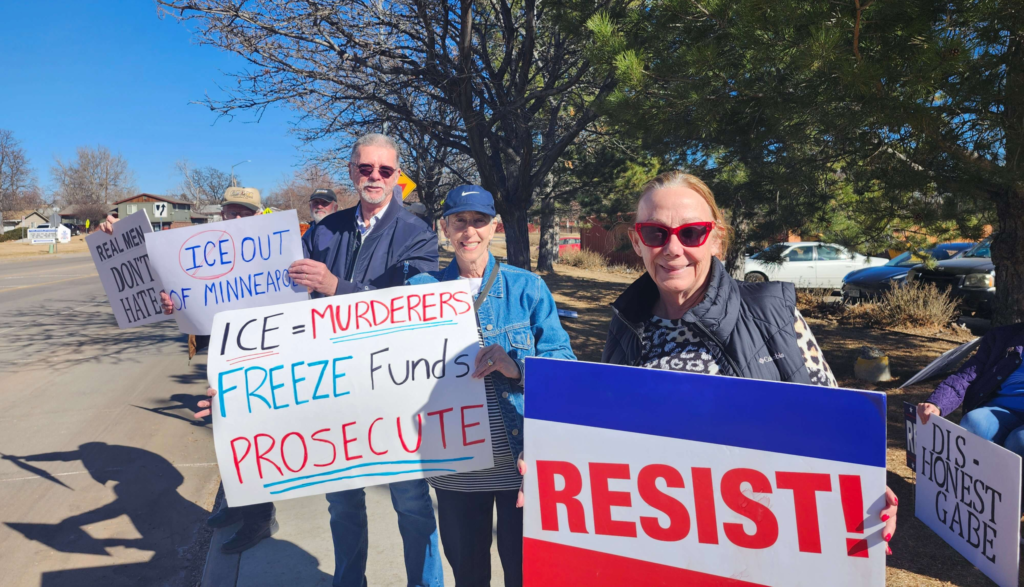
Since taking office in January 2025, Rep. Evans has refused to hold a single in-person town hall with his constituents. Weeks into his term, the National Republican Congressional Committee (NRCC) advised members like Evans not to hold in-person events — and Evans has complied. His spokeswoman dismissed constituents seeking a town hall as “paid liberal groups,” saying Evans wanted meetings to be “productive conversations and not shout fests.”
The pressure from his district has been intense and bipartisan. More than 350 community members showed up to a self-organized town hall Evans was personally invited to — his office denied receiving the invitation, despite a handwritten receipt signed by his staff at the time of delivery. Over 100 constituents attended a separate event. Thousands more packed a Greeley rally where Rep. Alexandria Ocasio-Cortez and Sen. Bernie Sanders filled the void Evans left. The DNC put up a billboard in his district calling him a “coward.”
Democrats organized a “People’s Town Hall” in Thornton, featuring a cardboard cutout of Evans — complete with chicken legs.
Evans eventually held a single telephone town hall in April 2025, answering just six questions over an hour — with many constituents reporting being dropped from the call due to technical problems. Telephone town halls allow members to screen questions, control participation, and avoid the unscripted accountability of a room full of voters.
The Constitution’s Check on Executive Power — Abdicated
Congress’s most fundamental role under the Constitution is to serve as a check on the executive branch — not a support structure for it. By voting with the Trump administration on every major issue and declining to demand any oversight, guardrails, or accountability from agencies like ICE and CBP despite documented abuses, Evans has effectively surrendered that constitutional responsibility. His district is closely divided. His margin of victory was 2,500 votes. The people of Colorado’s 8th District deserved a representative willing to push back when push back was warranted — not one who takes “100% credit” for the president’s agenda.
TAKE ACTION!
🔥 Make your voice heard
If you are in the district, your vote directly impacts representation and policy.
Voting is the most direct way to influence representation. Also get your friends and neighbors to register and vote!
Call Rep. Evans’ office: Let him know how his votes affect you and your community
- Northglenn: (303) 723-6560
- Greeley: (970) 324-2567
- Washington, D.C.: (202) 225-5625
🌎 If you are outside the district
Support civic engagement and accountability efforts.
Spread the Word – Share this Post!